About Millersylvania State Park
Millersylvania State Park is a 900-acre camping park on the shore of Deep Lake, about 20 minutes south of downtown Olympia. The Miller family left their homestead, which they called "Miller's Glade," to the State of Washington, which accepted it in 1924. Crews from the Civilian Conservation Corps then built most of the park's log and stone buildings by hand in the 1930s, and many of them still stand.
The Park at a Glance
The Land Before the Park
The park sits in the traditional territory of Coast Salish peoples. Washington State Parks names the Confederated Tribes of the Chehalis Reservation, the Nisqually Indian Tribe and the Squaxin Island Tribe among their present-day descendants. Under the 1854 Treaty of Medicine Creek, some tribes kept the right to harvest in their usual places, which State Parks says includes the lake, forests and wetlands of today's park.
After the 1854 government surveys, the land passed into private hands. Homestead patents went to Squire B. Sandreth and Isaac Sayles in 1875. A 160-acre parcel in the north part of today's park went to Andrew Jackson Burr in 1865, as an heir to a military warrant awarded to Territorial Governor Isaac Stevens.
The Miller Family
John Leonard Miller moved his family to what became Thurston County in 1881 and bought the Sandreth homestead by 1882, then the land around it. The family planted an orchard of 179 pear, apple and plum trees and sold timber to local sawmills. You can still walk the Orchard Trail on the park map.
Local stories made the Millers Austrian nobility in exile: a bodyguard to Emperor Francis Joseph I, a princess, a cavalry general. Washington State Parks calls these unsubstantiated legends. What is on record is that the family kept to itself, invited neighbors to camp by the lake on the Fourth of July and during salmon runs, and that none of the three children married.
In 1921 the son, Frederick, wrote a will that left the estate to the state for a park, so that everyone could keep enjoying "Miller's Glade." His sister Christina, the last of the family, signed a quitclaim deed on February 13, 1924, keeping the use of the house and enough land for two cows for the rest of her life. The State Parks Committee accepted it on April 7, 1924. Christina died in 1926, and the park was dedicated on August 10, 1928. The family later changed the name from Miller's Glade to Millersylvania, which the park brochure translates as "wooded glade."
The Civilian Conservation Corps
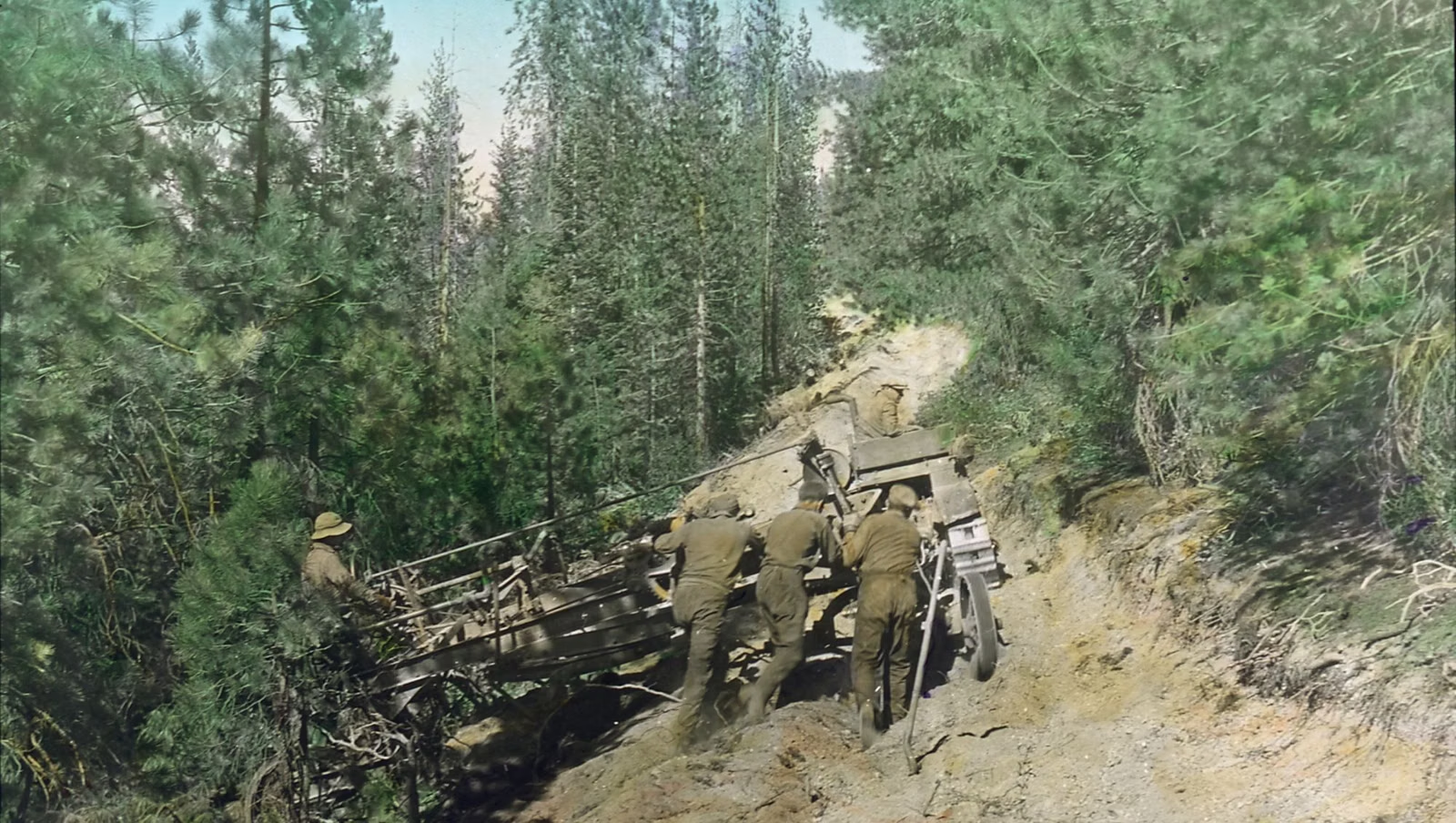
In October 1933, CCC Company 1232 arrived with 200 young men from New York and New Jersey. They lived in four bunkhouses near the old Miller house and orchard. By December they were felling snags, clearing debris, building trails and fire roads and splitting rail fence. In 1934 crews hewed fallen timber and cut locally quarried stone for the buildings.
Two more companies followed: Company 2935-V, made up of ex-servicemen, in 1936, and Company 938, many of them from Tacoma, at the end of 1937. By 1939 the CCC had built 17 large buildings, including a caretaker's house, a manager's office, two comfort stations, four kitchens, two bathhouses and a pump house.
A Hard Part of the Story
Washington State Parks tells this part plainly. In 1934 the state parks superintendent objected to the Black enrollees working at Millersylvania, and the State Parks Committee asked that they be kept away from visitors. A separate bathing beach was ordered for them, and the 51 Black enrollees were sent back east after six months. The agency's full history page covers it in detail.
Logging Relics in the Woods
Before the park, loggers worked these woods. The park brochure says remnants of a narrow-gauge railroad and several skid roads from 19th-century logging are still in the park, and some old stumps still show the notches where loggers set their springboards. Look for them along the trails through the big firs and cedars. See hiking.
The Park Today
Washington State Parks runs Millersylvania as a year-round camping park with two swimming beaches on Deep Lake, about 8.6 miles of hiking trails, a hand-carry boat launch, kitchen shelters, a lakeside cottage and a retreat center for groups. A Discover Pass is needed to park for the day. See plan your visit.
About This Site
This is an independent visitor guide. It is not run by Washington State Parks. Facts here come from the agency's park page, map, brochure and history page, and from the Washington Department of Fish and Wildlife for fishing. When the park changes something, the agency's page wins.
About Millersylvania State Park FAQ
Who owns Millersylvania State Park?
The State of Washington. The Miller family left their land to the state for a park, the State Parks Committee accepted the deed in 1924, and Washington State Parks manages it today.
Why is it called Millersylvania?
It is named for the Miller family, who homesteaded on Deep Lake from 1881. They first called the place "Miller's Glade" and later changed it to Millersylvania, which the park brochure translates as "wooded glade."
Who built the buildings at Millersylvania?
The Civilian Conservation Corps. Starting in 1933, CCC crews built the park's log and stone buildings, including kitchens, bathhouses and comfort stations. By 1939 they had built 17 large buildings.
When did Millersylvania become a state park?
The state accepted the Miller family's deed on April 7, 1924, and the park was dedicated on August 10, 1928.